Two Rivers’ utilities committee moved toward cleaning the city’s Lake Michigan water intake as its capacity declines, while wastewater staff reported a mercury permit exceedance and a costly PFAS sludge problem still waiting for a solution.
No public comments or communications recorded for this meeting.
The 2025 lead service line replacement contractor has largely finished its work, with restoration still underway on the east side. City crews still had about 40 pavement repairs remaining, although concrete work tied to the Emmet, 18th and 19th Street resurfacing areas was complete.
Page 1 — source unresolved
Mammoth Construction finished lead service line work on 23rd Street and was working on 26th Street. About 40 pavement openings still awaited restoration, with city crews expected to shift to this area near the end of August. Property owners are being notified block by block, but residents should still expect access delays while work and restoration continue.
Page 1 — source unresolved
The water-system project was still waiting for a preconstruction meeting to establish a firmer schedule. That leaves residents without a clear timeline for when construction impacts may begin.
Page 1 — source unresolved
A trial of a different chemical used to remove water from wastewater sludge did not reduce costs. It used about 10% more chemical, produced wetter sludge than the current product, and caused buildup on equipment that required extra cleaning. Staff’s test avoided adopting a change that would have performed worse on both cost and operations.
Page 1 — source unresolved
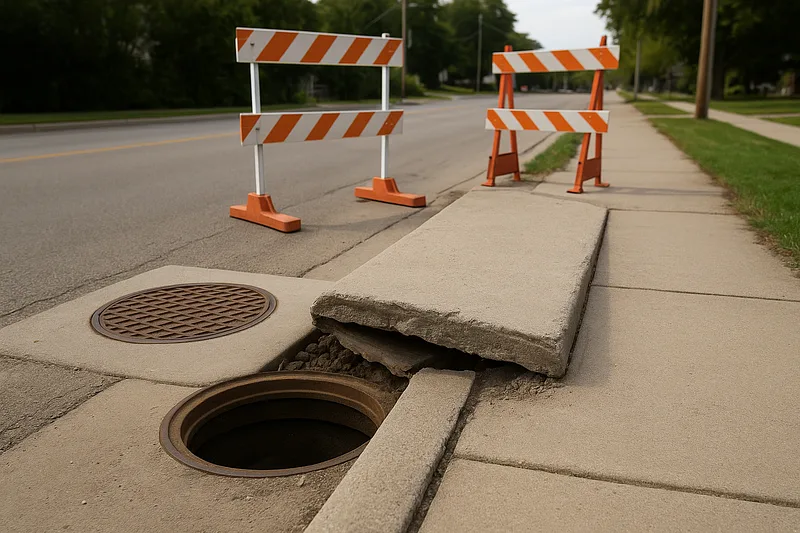
During work to raise covers to match a new sidewalk, the original wet-well cover broke and fell into the lift station, damaging a level sensor and pump-hanger bracket. Staff used city and contractor vacuum trucks to keep the station operating, and no sewer bypass, sanitary sewer release or injuries were reported. A replacement cover must be built, delaying the lift station and sidewalk project by an estimated four to six weeks.
Page 2 — source unresolved
The wastewater plant reported a mercury result of 2.1 nanograms per liter, above its 1.3 limit, to the Wisconsin Department of Natural Resources. Staff believes the result may have been an outlier connected to sediment flushed during water-plant tank cleaning and heavy rain, since the next sample was 0.65. That explanation is not a resolution; continued sampling will determine whether the exceedance was isolated or points to a recurring problem.
Pages 2-3 — source unresolved
The state approved the city’s PFAS discharge report and found no current reason to require a plan to reduce PFOA or PFOS in treated wastewater released to Lake Michigan. But PFAS remains in the plant’s sludge, and the city says disposal will remain a challenge likely to involve significant future costs. The state finding addresses liquid discharge, not the unresolved sludge-disposal bill.
Page 3 — source unresolved
After several rounds of revisions, the Wisconsin Department of Natural Resources approved the city’s sewer-system operations and overflow-response plans. The plans must be reviewed at least yearly and updated as needed, making this a compliance milestone rather than a finished task.
Page 3 — source unresolved
State regulators warned Wisconsin water and wastewater utilities about attempts to gain unauthorized access through internet-exposed control equipment. Staff said the wastewater plant is protected and has mechanical backups that would allow it to keep operating during a cyberattack or system failure.
Page 3 — source unresolved
The electric utility director asked committee members what they want researched before further discussion of extending the city’s WPPI contract. The September WPPI meeting in Sheboygan was presented as a chance for committee and council members to compare experiences with other member communities. No decision on an extension was recorded.
Page 3 — source unresolved
Two Rivers sent two electric crews to help Fox Crossing, Neenah and Menasha after the July 27 tornado, then recalled them because of its own staffing conflicts and shortages. The utility also supplied six 50-foot poles and may be asked to send crews again. Mutual aid helps neighboring communities recover, but the recall underscores the limited staffing cushion available at home.
Pages 3-4 — source unresolved
The water utility director is gathering information from communities that stopped adding fluoride years ago, following a City Council work session. Committee and council members have received public feedback both supporting and opposing fluoride, but no additional questions or decision were recorded at this meeting.
Page 4 — source unresolved
The committee gave verbal consensus to begin the roughly year-long state permitting process for cleaning the water utility’s 6,500-foot Lake Michigan intake pipe and to include a budget placeholder in 2027. The pipe was about 80% blocked by sand before its 2017 cleaning, and current capacity has fallen to about 2,500 gallons per minute. Staff says cleaning becomes increasingly important as capacity approaches 3,500 gallons per minute, so delaying the permitting process would leave the city with less room to respond if the intake continues to clog.
Page 4 — source unresolved