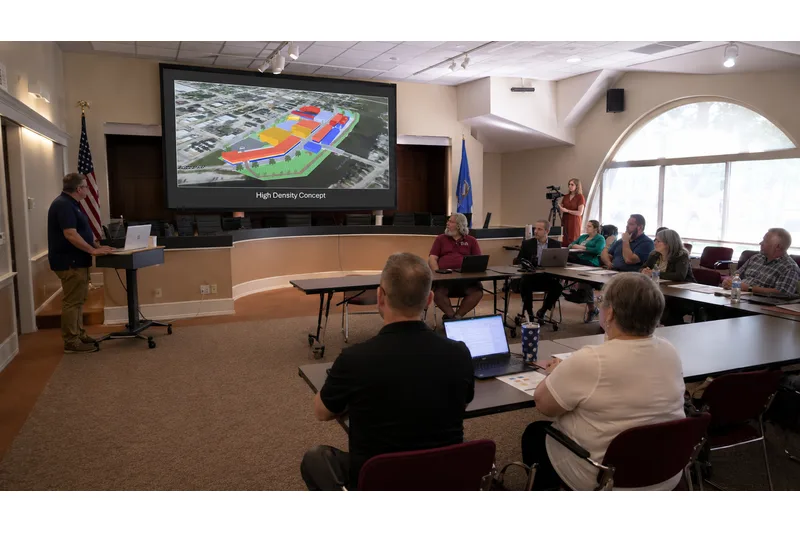
Council got an early look at three redevelopment concepts for the Hamilton waterfront site, but made no decisions yet. The only vote was a time-sensitive paperwork step to keep the city eligible for low-interest state loans for 2027 water/sewer work.
No public comments or communications recorded for this meeting.
Council reviewed three preliminary concept maps for redeveloping the 14-acre Hamilton property, built from roughly 600 survey responses and student workshops, but took no formal action. Staff reported encouraging environmental test results (10 soil cores below DNR PFAS screening levels), which could help the city pursue an environmental liability exemption—an important step before serious redevelopment talks. The discussion focused on real-world tradeoffs: whether a conference hotel is a smart bet, what expanded park space would cost to maintain long-term, and how expensive stormwater fixes could get under a higher-density plan. Next steps include publishing the slide deck, running a public survey (July 6 to mid-August), and holding three listening sessions before a targeted final concept comes to council Sept. 21.
Page 1 — source unresolved
Council heard a detailed warning about PFAS showing up in wastewater solids, with staff pointing to leachate from the city’s closed landfill as a major source. The immediate problem is practical and time-bound: the city says its two main farm partners no longer want the sludge, and the city produces about 18,000 cubic yards a year with roughly 12 months of storage left—meaning a disposal plan (and likely new costs) is needed soon. Staff outlined possible stopgaps (private hauling, testing sludge mixed with street sweepings for landfill cover) and longer-term options like a roughly $1 million treatment system for landfill leachate, while noting the DNR isn’t requiring a cleanup yet but could within about five years. No vote was taken, but the city is eyeing a new state PFAS grant program that would still require a 20% local match—money that would have to come from somewhere.
Page 1 — source unresolved
Council unanimously approved a required “intent” resolution so the city can pay early project costs and later reimburse itself using state Clean Water/Safe Drinking Water financing for 2027 work. Staff emphasized this is a deadline-driven eligibility step required by the DNR before June 30, and it does not approve construction or lock in the full estimated borrowing (not to exceed $11.5 million). The plan described includes major replacements on very old sewer mains (90–100 years) and an aggressive push to replace lead service laterals—aiming for 500 total services in 2027 to capture federal infrastructure funding while it’s still available. Residents should watch the next steps closely, because the real decision points—final scope, timing, and the actual borrowing—come later, and that’s where costs and disruption become concrete.
Page 2 — source unresolved
Roll call vote
8 yes